When I read through Don Delillo's Libra, the character of Lee always intrigued me. It felt like Lee was always reinventing himself in a variety of different ways. Every single chapter was a different Lee. A different face of the man. It was fascinating and it reminded me of some other book that I read. But it evaded me for so long.
After thinking hard about this forgotten book it finally came to me. The other book was Phillip Pullman's The Good Man Jesus and the Scoundrel Christ, which is a very interesting read that I encourage anyone who is interested in different historical perspectives to take a look at. Basically the point of the novel is to take the historical figure of Jesus Christ and split him into two characters. There's the miracle working, peace loving, and genuine teacher of Jesus, and his brother the cold, calculating, and manipulative Christ who is obsessed with making a powerful organization in his brothers wake. This was the book I was waiting to make the connection with, because we can turn Oswald into two different people to fit into the narrative.
I think if we were to split Oswald into separate people I think it would look like this. Lee would be the lonely and bullied child who's desperate to see himself in the spotlight for once. Harvey, the despicable smirking young adult that waits in silence to piss off whatever authority is hanging over him. Finally, Oswald the blood thirsty assassin that always tries to cement himself into history by writing fake diaries and coming up with alias'.
Although this is a fun thought experiment to separate the man, Lee Harvey Oswald, into different yet easier to understand personalities, I think it would spoil his legacy. I think that one of the main factors that keeps Oswald so interesting sixty years later, is his unpredictability. Oswald is an enigma, even to the narrator of Libra. No one knows exactly why he does the things he does except for him. If we divided him up like I mentioned above, we'd lose that measure of chaos that is essential to Oswald. The magic of Oswald would be over and we'd know exactly what he (or they) did and why.
Even though Don Delillo's Libra is supposed to be centrally be about the JFK assassination and the plots that surround it, I find that the character of Lee is what keeps us guessing and keep us interested in the proceedings. Lee's apparent simple mindedness and baffling complexity keeps us interested in his story and by splitting him up into multiple people I feel the story would lose a lot of it's charm.
Monday, May 16, 2016

Thursday, April 14, 2016
The Libra in Libra
Often times when people read a book, the title becomes apparent
as we read it. As we read a novel in the Harry Potter series we know it’s
called Harry Potter because the book’s protagonist is named “Harry Potter.”
Sometimes it’s harder to tell why the title of a book is the way it is. When
reading The Scarlet Letter, we find
out later in the book that the title refers to the punishment the main character
receives for practicing adultery. The title isn’t immediately apparent when we
read the first page, but by reading the novel we figure out the meaning behind
the title.
This system doesn’t apply to Libra I feel. You enter the book not knowing why Don DeLillo chose
that certain title. After reading a good way through the book however you still
don’t know why. It’s annoying. Why couldn’t he just title it The Slightly Real Story Behind the Assassin
of John Fitzgerald Kennedy Known as Lee Harvey Oswald and the Secret Plots he
may have been Involved in! That would have been much easier to understand.
But more often than not, the
mystery of a phrase makes it a lot more fun to speculate on. Citizen Kane would have been a much less
interesting movie if they told you what the phrase “Rosebud” meant in the first
line. So I’m going to speculate on the meaning of the title of Libra, because that’s fun.
The only other context that I
have seen the word “Libra” used is in astrological signs. I only know that because
my Father is a Libra. So maybe that has something to do with it. Within a quick
google search I can see that Oswald’s birthday (October 18, 1939) falls within
the range of dates that makes one a Libra.
But why would Delillo make Oswald’s
astrological sign, a thing that most people don’t pay attention to anyway, the
title for this conspiracy laden book? I start to look up personality traits for
Librans (as they are supposedly called) but half of them are about their
romantic capabilities and the other half contradict each other. One source
might say that a Libra is always an outcast, depressed, and very prone to acts
of violence (sounds a bit like Oswald, doesn’t it?) while another says that a
Libra will try to see all perspectives on an argument and will try to remain a
pacifist in any confrontation (Not characteristics of Oswald.) This information
is kind of useless, random, and doesn’t come to any meaningful conclusion.
Right as I was about to abandon
this venture, I see that the symbol of the sign Libra is the scales. The same
symbol that appears on the front of my copy of Libra. To be more specific, my cover shows the scales and a bullet
in front of them. This makes me form a hypothesis that instead of the astrological
sign, and all of its horoscopes and predictions, being the important part, the
symbol of the scales matters the most. The imagery of the bullet and the scales
seems to suggest that we are judging a man based wholly on the bullets he fired
at the president. All of our judgement is on these three bullets.
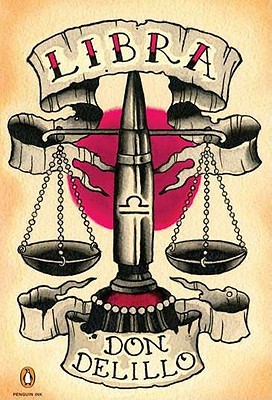
That’s when it hit me. The
purpose of the book is to provide a logical but fictional telling of the
factors leading up to the assassination of John F. Kennedy. Don Delillo is
trying to instead take our judgment off of those three bullets and instead
judge the people involved in the assassination by their entire story. By the
end of this book we will not see Lee Harvey Oswald as the three bullets fired
at the president, but as a man with a story of his own. Then, when we see the
whole story, the scales will be even. Only then we can pass judgment on Oswald
and his actions.
Time Travel
Time travel is a spooky thing. We have a large section of our media devoted to it because the possibilities it introduces are so extraordinary. What would happen if I could travel back to this point in time? Would I be able to make a difference, or would the future stay exactly the same? Any time we are asking questions about time travel, no clear cut answers are given. Nothing is ever concrete in a time period that is constantly shifting around. But although we can never predict what time travel will affect in a timeline, we can predict how the features of a media's time travel can have an effect on the story itself.
In the novel Kindred, we can see Octavia Butler using a randomly spawning time travel that always transports her to a certain time and place. Although the circumstances she arrives to always pertain to the near death of Rufus, we can never predict what that situation will be. This generates a certain suspense, because the reader is just as clueless as Dana when she arrives in Maryland each time she time travels. It can also be observed that Kindred, only takes place in the present and 1800's Maryland. No other times are present in the novel and so it allows the characters and story to develop greatly, as we see them mature and see how their decisions affect their environment.
This can be contrasted with Kurt Vonnegut's Slaughterhouse Five, considering that this other work of postmodern fiction also includes a time travel mechanic. In Slaughterhouse Five, we can see that the time travel the reader and Billy Pilgrim experience is not determined to go to a certain time or place, but are instead deposited at a random part of Billy's life. However, in contrast to Kindred, the confusion we experience when Billy jumps through time is not based on the circumstance he is immediately placed in but by the setting itself. We are more focused on finding out what year we are in and what place is being described when the jump ends. I think this allows Slaughterhouse Five to focus less on plot and more on the morals that hold the book together. Such as the antiwar attitude of Vonnegut and the irony found in the bombing of Dresden.
Although both of these books rely heavily on time travel to advance their plots and convey their complex issues, they do it in very different ways. Kindred uses a definite ending point for Dana to end up every time she time travels allowing the reader to focus more on the characters living there. On the other hand, Slaughterhouse Five makes the reader confused on their place and time and subsequently conveys it's morals using moments carved out of this mesh of confusion.
The Climax of a Book that Tells You the Climax
In the first chapter of Slaughterhouse Five, Vonnegut says that "'I think the climax of the book will be the execution of poor old Edgar Derby' I said 'The irony is so great. A whole city gets burned down, and thousands and thousands of people are killed. And then this one American foot solider is arrested in the ruins for taking a teapot. He's given a regular trial, and then he's shot by a firing squad.'" Although this is Vonnegut telling about his experience trying to write his "big war novel," this scene of Edgar Derby's execution does appear in the book. But in my opinion, in the novel Vonnegut wrote, this is not the climax of the story.
This scene of Derby's execution certainly could be the climax, but it's not because the author told us the event before it happened. We knew that after reading the first chapter that after the Dresden firestorm, an unknown character called Edgar Derby would eventually pick up a teapot and be executed for it. That event is already on our timeline. Because of this, that point isn't the climax of the story because it holds no sway over us. It's as if J.K. Rowling had said at the beginning of the first Harry Potter book, that Voldemort would kill Harry and it would be revealed that Harry himself is a horcrux and they have one last climactic fight where Voldemort is defeated. We have no idea who these characters are or what a horcrux is but we have already plotted that point as the most tense point in the story. So when we finally get to it, there's no suspense. What a bummer. So there evolves a new climax that the reader decides is point of most tension.
I have a different point where I feel the tension is highest and where the story of Slaughterhouse Five is the most compelling. It's another point with Edgar Derby. It's where he is debating with Campbell about the meaning of American justice and the American way. He just starts talking about everything a die hard patriot would talk about. All of this is happening while "The air-raids sirens howl mournfully." Although this isn't the night that Dresden is bombed, this scene was also one we never saw coming. It became the new climax for me because of that.
It also became the new climax because as I looked back on this book a while later I saw that of all the events that happened (the alien abduction, the death of thousands, the rearrangement of time) this is the part I love to re-read the most. There's so much irony and so much hypocrisy in a man arguing on behalf of American ideals only to be bombed by American bombers the next day.
Overall, because of the suspense of the bombing being ruined by the structure of the novel and the lasting impact that Edgar Derby's speech had on me individually, I would give the prize of climax to this scene. Although the bombing of Dresden and the subsequent execution of Edgar Derby still had punch, they fell flat in comparison to the shock that Edgar Derby's speech delivered out of the blue. Maybe that was the intended purpose of the introduction. To take the punch out of the bombing. To take the punch out of war and allow a simple speech about ideals take the spotlight.
This scene of Derby's execution certainly could be the climax, but it's not because the author told us the event before it happened. We knew that after reading the first chapter that after the Dresden firestorm, an unknown character called Edgar Derby would eventually pick up a teapot and be executed for it. That event is already on our timeline. Because of this, that point isn't the climax of the story because it holds no sway over us. It's as if J.K. Rowling had said at the beginning of the first Harry Potter book, that Voldemort would kill Harry and it would be revealed that Harry himself is a horcrux and they have one last climactic fight where Voldemort is defeated. We have no idea who these characters are or what a horcrux is but we have already plotted that point as the most tense point in the story. So when we finally get to it, there's no suspense. What a bummer. So there evolves a new climax that the reader decides is point of most tension.
It also became the new climax because as I looked back on this book a while later I saw that of all the events that happened (the alien abduction, the death of thousands, the rearrangement of time) this is the part I love to re-read the most. There's so much irony and so much hypocrisy in a man arguing on behalf of American ideals only to be bombed by American bombers the next day.
Overall, because of the suspense of the bombing being ruined by the structure of the novel and the lasting impact that Edgar Derby's speech had on me individually, I would give the prize of climax to this scene. Although the bombing of Dresden and the subsequent execution of Edgar Derby still had punch, they fell flat in comparison to the shock that Edgar Derby's speech delivered out of the blue. Maybe that was the intended purpose of the introduction. To take the punch out of the bombing. To take the punch out of war and allow a simple speech about ideals take the spotlight.
The Purposeful and the Passive
In Slaughterhouse Five, every time a person dies the
narrator says the phrase “so it goes”. Everyone who has read the story is aware
of this. Considering this a book concerning the Second World War and the
bombing of Dresden, the topic of death is everywhere. Everyone seems to be
equal parts confused and outraged the narrator would treat the topic of the deaths of thousands, with such a dismissive phrase. However, I’d argue that we’ve all been
saying “so it goes” our entire lives.
What do I mean? Well, as we all know, human beings aren’t
the most caring creatures ever made. We have made war into a fine science and
done awful things to each other. But for an individual to admit that they
themselves are awful to others at times is a hard thing to do. Where am I going
with this? I am headed into the subject of empathy. When someone we know dies
we feel a pang of grief deep inside of us. When someone we care about and have a close connection to dies it
often leads to tears and a state of grief for long periods of time. It’s a
natural thing to happen to us. Those are the feelings we conjure up when we think of people dying. Tears and depression. However, we hear about people dying all the time. People die in movies, people die in novels, and people die in jokes. We are constantly assaulted with images and tales of death. One of the most common places to talk about people dying is in, say, a history class. You get endless amounts of numbers of people that die in certain events. Some in wars, some in plagues, and some in needless bloodshed. Over the course of human history estimates say that over one hundred billion people have died. Eventually, hearing that one hundred people died in a certain political rally doesn’t matter to you anymore. We become desensitized to it.
That’s where I’m going. You might get angry to hear that
some twenty five thousand people died in the firebombing of Dresden. But that
will soon fade. You’ll be in math class in an hour and your brain will forget
it until the next time it comes up. Your mind will passively say “so it goes”.
You’ll forget and brush these deaths off your conscious so you can focus on other things. After all, you don't know anyone who died in Dresden. You haven't had a deep connection with someone who died in Dresden. It's just a number. 25,000.
But the notion of death still holds traction in our mind.
When we think of death, again we think about loved ones dying. This makes Vonnegut’s
“so it goes” insulting and dismissive to our idea of death. Vonnegut is taking our passive shrugging off of deaths in history, and making us think about it in a critical manner. As Vonnegut stated, this is an antiwar novel and the best way to possibly stop war is to get rid of this passive "so it goes" and start to analyze our own humanity and empathy for the dead.
That’s my interpretation of the “so it goes." Take it or leave it.
Monday, February 1, 2016
Bias' and Immersion
Over the past four weeks many things have changed. I'm starting to get organized in as many ways as possible, people are starting to think about whether history and fiction are essentially the same, and I don't know maybe someone in our school got a new dog. The one thing that hasn't changed in this month has been the persistence of one idea in our discussion. Now, I'm not saying everyone brings this topic up constantly (mainly it's just one person) but that repeatedly it overrides whatever we are talking about.
This topic is bias.
Now bias in itself is not a bad topic. Everyone has bias' and everyone should have something to contribute. But there is one specific aspect of bias that has really been irritating me. Every once in a while, one particular student will say that when composing a piece of history, fiction, or any source of media that the author should alert the reader towards their personal bias'. Hmmm...that's intersting I suppose. The strange thing is that this student thinks this will make the media more immersive.
That's my problem.
Postmodernism is great to think about in a controlled setting but if we use it in every story it would become maddening. You're reading a history book composed by a white man and at the beginning of every chapter he must preface it with this:
"Note: I am a white male American. I may misrepresent the following groups in this chapter on Railroads: Women, Immigrants, African Americans, Non-Americans, People of Asian descent, Native Americans, People of Eastern European Descent, People of Jewish Descent, Extremely Wealthy People, Extremely Poor People, Elderly People, Children, Railroad Workers, Steel Workers, Animals, Trees, Trains, Several Biscuits, and etc. All of these will feature prominently in the story of American Railroads."
Every chapter.
Every book.
Every single time.
Now I don't know about anyone else, but to me that sounds awful. The entire point of reading a story is to immerse yourself in it and take in the meaning in the words. If someone tells you every single bias (which I believe no one can know themselves that well, but that's a topic for another time) then it rips you from the story and plops you right back into your chic twenty-first century living room. What a drag. So much for escaping reality.
Or how about this, you're at a party and someone is telling you about this time that they went to nice restaurant in Chicago, JUST KIDDING! BEFORE THEY DO THAT, THEY HAVE TO LIST THEIR BIAS'!
Would that ever happen? No of course not. We're not robots. We're human and we have bias'. The fun part of any analytical media is to find the creator's bias and examine why that is there and how we can interpret the story differently. That's what I perceive as postmodernism.
Food for Thought.
This topic is bias.
Now bias in itself is not a bad topic. Everyone has bias' and everyone should have something to contribute. But there is one specific aspect of bias that has really been irritating me. Every once in a while, one particular student will say that when composing a piece of history, fiction, or any source of media that the author should alert the reader towards their personal bias'. Hmmm...that's intersting I suppose. The strange thing is that this student thinks this will make the media more immersive.
That's my problem.
Postmodernism is great to think about in a controlled setting but if we use it in every story it would become maddening. You're reading a history book composed by a white man and at the beginning of every chapter he must preface it with this:
"Note: I am a white male American. I may misrepresent the following groups in this chapter on Railroads: Women, Immigrants, African Americans, Non-Americans, People of Asian descent, Native Americans, People of Eastern European Descent, People of Jewish Descent, Extremely Wealthy People, Extremely Poor People, Elderly People, Children, Railroad Workers, Steel Workers, Animals, Trees, Trains, Several Biscuits, and etc. All of these will feature prominently in the story of American Railroads."
Every chapter.
Every book.
Every single time.
Now I don't know about anyone else, but to me that sounds awful. The entire point of reading a story is to immerse yourself in it and take in the meaning in the words. If someone tells you every single bias (which I believe no one can know themselves that well, but that's a topic for another time) then it rips you from the story and plops you right back into your chic twenty-first century living room. What a drag. So much for escaping reality.
Or how about this, you're at a party and someone is telling you about this time that they went to nice restaurant in Chicago, JUST KIDDING! BEFORE THEY DO THAT, THEY HAVE TO LIST THEIR BIAS'!
Would that ever happen? No of course not. We're not robots. We're human and we have bias'. The fun part of any analytical media is to find the creator's bias and examine why that is there and how we can interpret the story differently. That's what I perceive as postmodernism.
Food for Thought.
Wednesday, January 6, 2016
Subscribe to:
Posts (Atom)